Skip to content
  • Home
  • 中文 (香港)
Solving Master

Solving Master

Resources for HKDSE Mathematics

  • Revision Note
    • Math
      • Number and Algebra
        • Complex Number
        • Errors and Estimations
        • Exponential and Logarithm
        • Identities
        • Inequalities
        • Percentage
        • Polynomials
        • Quadratic Equation and Function
        • Sequences
        • Variations
      • Measures, Shape and Space
        • Coordinates
        • Lines and Angles
        • Mensuration
        • Properties of Circle
        • Quadrilaterals
        • Transformations
        • Triangles
        • Trigonometry
      • Data Handling
        • Probability
        • Statistics
    • M2
      • Mathematical Induction
      • Binomial Theorem
      • Trigonometry (M2)
  • HKDSE-MATH
    • 2023
      • Paper 1
      • Paper 2
    • 2022
      • Paper 1
      • Paper 2
    • 2021
      • Paper 1
      • Paper 2
    • 2020
      • Paper 1
      • Paper 2
    • 2019
      • Paper 1
      • Paper 2
    • 2018
      • Paper 1
      • Paper 2
    • 2017
      • Paper 1
      • Paper 2
    • 2016
      • Paper 1
      • Paper 2
    • 2015
      • Paper 1
      • Paper 2
    • 2014
      • Paper 1
      • Paper 2
    • 2013
      • Paper 1
      • Paper 2
    • 2012
      • Paper 1
      • Paper 2
    • 2012PP
      • Paper 1
      • Paper 2
    • 2011SP
      • Paper 1
      • Paper 2
  • HKDSE-M2
    • 2023
    • 2022
    • 2021
    • 2020
  • HKCEE
    • 2011
      • Paper 1
      • Paper 2
    • 2010
      • Paper 1
      • Paper 2
    • 2009
      • Paper 1
      • Paper 2
    • 2008
      • Paper 1
      • Paper 2
    • 2007
      • Paper 1
      • Paper 2
    • 2006
      • Paper 1
      • Paper 2
  • Other Resources
  • Toggle search form

2009-II-53

Posted on 16-06-202121-06-2023 By app.cch No Comments on 2009-II-53
Ans: C

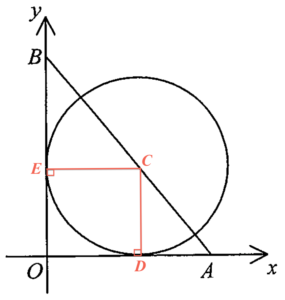
Denote $C$ the centre of the circle. Let $D$ and $E$ be the points of contact of $OA$ and $OB$ respectively. Let $r$ be the radius. Note that $CD = CE = OE = OD = r$. Note also that the coordinates of $C$ are $(r,r)$. Since the coordinates of $A$ are $(21,0)$, then $OA = 21$. And Since the coordinates of $B$ are $(0,28)$, then $OB=28$ and $BE = 28 -r$. Note that $\Delta OAB \sim \Delta ECB$, then we have

$\begin{array}{rcl}
\dfrac{OA}{EC} & = & \dfrac{OB}{EB} \\
\dfrac{21}{r} & = & \dfrac{28}{28-r} \\
21(28-r) & = & 28r \\
588 – 21r & = & 28r \\
49r & = & 588 \\
r & = & 12
\end{array}$

Therefore, the radius is $12$ and the coordinates of the centre are $(12,12)$. Hence, the equation of the circle

$\begin{array}{rcl}
(x-12)^2 + (y-12)^2 & = & 12^2 \\
x^2 -24x +144 + y^2 -24y + 144 & = & 144 \\
x^2 +y^2 -24x – 24y +144 & = & 0
\end{array}$

Same Topic:

Default Thumbnail2006-I-16 Default Thumbnail2006-II-50 Default Thumbnail2007-II-51 Default Thumbnail2008-I-17
2009, HKCEE, Paper 2 Tags:Equations of Circle

Post navigation

Previous Post: 2009-II-52
Next Post: 2009-II-54

Leave a Reply Cancel reply

Your email address will not be published. Required fields are marked *

Topic Cloud

3D Problems (41) Basic Functions (13) Basic Geometry (68) Binomial Theorem (7) Change of Subject (32) Complex Numbers (16) Coordinates (46) Differentiation (16) Equations of Circle (54) Equations of Straight Line (43) Estimations and Errors (35) Factorization (39) Graph of Functions (3) Inequality (39) Integration (15) Laws of Indices (43) Linear Programming (21) Locus (13) Logarithm (34) Mathematical Induction (7) Matrices (4) Mensuration (98) Numeral System (19) Percentage (42) Polynomials (49) Probability (85) Properties of Circles (56) Quadratic Equations and Functions (57) Rate and Ratio (30) Rational Functions (20) Sequences (66) Simultaneous Linear Equations (27) Statistics (122) System of Linear Equations (3) Transformations (44) Trigonometry (M2) (7) Trigonometry and Its Applications (67) Variations (38) Vectors (3)

Copyright © 2026 Solving Master.

Powered by PressBook Grid Blogs theme