- Sketch a graph according to the question.
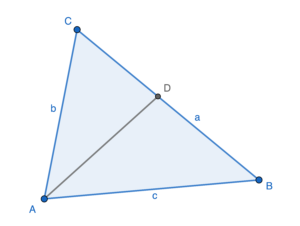
- It is given that $BD:DC=c:b$. Hence by section formula, we have
$\begin{array}{cl}
& \av{AD} \\
= & \dfrac{b\av{AB}+c\av{AC}}{b+c} \\
= & \dfrac{b}{b+c}(\av{OB}-\av{OA})+\dfrac{c}{b+c}(\av{OC}-\av{OA}) \\
= & \dfrac{-(b+c)}{b+c}\av{OA}+\dfrac{b}{b+c}\av{OB}+\dfrac{c}{b+c}\av{OC} \\
= & -\av{OA}+\dfrac{b}{b+c}\av{OB}+\dfrac{c}{b+c}\av{OC}
\end{array}$ - Sketch a graph according to the question.
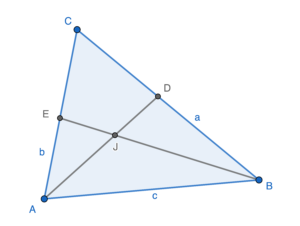
$\begin{array}{cl}
& \av{AJ} \\
= & \av{OJ}-\av{OA} \\
= & \dfrac{a}{a+b+c}\av{OA}+\dfrac{b}{a+b+c}\av{OB}+\dfrac{c}{a+b+c}\av{OC}-\av{OA} \\
= & \dfrac{-(b+c)}{a+b+c}\av{OA}+\dfrac{b}{a+b+c}\av{OB}+\dfrac{c}{a+b+c}\av{OC} \\
= & \dfrac{b+c}{a+b+c}\left(-\av{OA}+\dfrac{b}{b+c}\av{OB}+\dfrac{c}{b+c}\av{OC} \right) \\
= & \dfrac{b+c}{a+b+c}\av{AD}
\end{array}$Since $a$, $b$ and $c$ are positive real numbers, then we have $0 < \dfrac{b+c}{a+b+c} < 1$.
Hence, $\av{AJ}=t\av{AD}$ for $t\in(0,1)$.
Therefore, $J$ lies on $AD$.
By comparing the given condition of (a) and (a)(ii), we have $AE:EC=c:a$. Then by the same method of (a)(i), we have
$\begin{array}{rcl}
\av{BE} & = & \dfrac{a}{a+c}\av{OA}-\av{OB}+\dfrac{c}{a+c}\av{OC}
\end{array}$Therefore, we have
$\begin{array}{cl}
& \av{BJ} \\
= & \av{OJ}-\av{OB} \\
= & \dfrac{a}{a+b+c}\av{OA}+\dfrac{b}{a+b+c}\av{OB}+\dfrac{c}{a+b+c}\av{OC}-\av{OB} \\
= & \dfrac{a}{a+b+c}\av{OA}+\dfrac{-(a+c)}{a+b+c}\av{OB}+\dfrac{c}{a+b+c}\av{OC} \\
= & \dfrac{a+c}{a+b+c}\left(\dfrac{a}{a+c}\av{OA}-\av{OB}+\dfrac{c}{a+c}\av{OC}\right) \\
= & \dfrac{a+c}{a+b+c}\av{BE}
\end{array}$Since $a$, $b$ and $c$ are positive real numbers, then we have $0 < \dfrac{a+c}{a+b+c} < 1$.
Hence, $\av{BJ}=t\av{BE}$ for $t\in(0,1)$.
Therefore, $J$ lies on $BE$.
Hence, $AD$ and $BE$ intersect at $J$.
- It is given that $BD:DC=c:b$. Hence by section formula, we have
-
- Since the point $J$ in (a) is the intersection point of two angle bisectors of $\Delta ABC$, then $J$ is the incentre of $\Delta ABC$.
In (b), $I$ is the incentre of $\Delta ABC$. Hence, we have
$\begin{array}{rcl}
\av{OI} & = & \dfrac{a}{a+b+c}\av{OA}+\dfrac{b}{a+b+c}\av{OB}+\dfrac{c}{a+b+c}\av{OC} \ \ldots \unicode{x2460}
\end{array}$$\begin{array}{cl}
& a \\
= & BC \\
= & |\av{OC}-\av{OB}| \\
= & | -3\bv{j}+\bv{k}-40\bv{i}+3\bv{j}-\bv{k}| \\
= & |-40\bv{i}| \\
= & 40
\end{array}$$\begin{array}{cl}
& b \\
= & AC \\
= & |\av{OC}-\av{OA}| \\
= & |-3\bv{j}+\bv{k}-35\bv{i}-9\bv{j}-\bv{k}| \\
= & |-35\bv{i}-12\bv{j}| \\
= & \sqrt{(-35)^2+(-12)^2} \\
= & 37
\end{array}$$\begin{array}{cl}
& c \\
= & AB \\
= & |\av{OB}-\av{OA}| \\
= & |40\bv{i}-3\bv{j}+\bv{k}-35\bv{i}-9\bv{j}-\bv{k}| \\
= & |5\bv{i}-12\bv{j}| \\
= & \sqrt{(5)^2+(-12)^2} \\
= & 13
\end{array}$Hence from $\unicode{x2460}$, we have
$\begin{array}{cl}
& \av{OI} \\
= & \dfrac{40}{40+37+13}(35\bv{i}+9\bv{j}+\bv{k})+\dfrac{37}{40+37+13}(40\bv{i}-3\bv{j}+\bv{k})+\dfrac{13}{40+37+13}(-3\bv{j}+\bv{k}) \\
= & 32\bv{i}+\dfrac{7}{3}\bv{j}+\bv{k}
\end{array}$ - Sketch a graph according to the question. Denote the point of contact of the inscribed circle and $AB$ by $F$. Note that $\angle AFI=90^\circ$ and $FI$ is a radius of the inscribed circle.
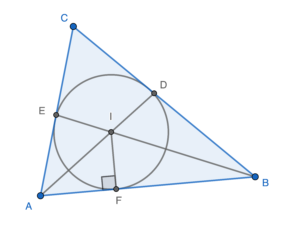
Consider $\Delta AFI$,
$\begin{array}{cl}
\sin \angle FAI & = & \dfrac{FI}{AI} \\
FI & = & AI\sin \angle FAI \ \ldots \unicode{x2461}
\end{array}$Also,
$\begin{array}{cl}
& \av{AI}\times \av{AB} \\
= & (\av{OI}-\av{OA})\times \av{AB} \\
= & \left(32\bv{i}+\dfrac{7}{3}\bv{j}+\bv{k}-35\bv{i}-9\bv{j}-\bv{k}\right)\times (5\bv{i}-12\bv{j}) \\
= & \left(-32\bv{i}-\dfrac{20}{3}\bv{j}\right)\times (5\bv{i}-12\bv{j}) \\
= & \begin{vmatrix} \bv{i} & \bv{j} & \bv{k} \\ -3 & \dfrac{-20}{3} & 0 \\ 5 & -12 & 0 \end{vmatrix} \\
= & \bv{k} \begin{vmatrix} -3 & \dfrac{-20}{3} \\ 5 & -12 \end{vmatrix} \\
= & \dfrac{208}{3}\bv{k}
\end{array}$On the other hand,
$\begin{array}{rcl}
|\av{AI}\times \av{AB}| & = & (AI)(AB)\sin\angle BAI \\
\left|\dfrac{208}{3}\bv{k}\right| & = & 13(AI)\sin\angle FAI \\
AI\sin \angle FAI & = & \dfrac{16}{3} \ \ldots \unicode{x2462}
\end{array}$By $\unicode{x2461}$ and $\unicode{x2462}$, we have $FI=\dfrac{16}{3}$.
Therefore, the radius of the inscribed circle is $\dfrac{16}{3}$.
- Since the point $J$ in (a) is the intersection point of two angle bisectors of $\Delta ABC$, then $J$ is the incentre of $\Delta ABC$.
2022-M2-12
Ans: (b) (i) $32\bv{i}+\dfrac{7}{3}\bv{j}+\bv{k}$ (ii) $\dfrac{16}{3}$